Day 4Sunday, September 13, 2026Bastogne, Belgium
East to Belgium: McAuliffe Square and Bois Jacques
1944
On 18 December 1944 the 101st Airborne was trucked into Bastogne overnight from a rest camp in France — short of ammunition, winter clothing and, in many cases, helmets. By 21 December seven German divisions had closed the ring around them.
2026
The long drive east out of Normandy, and then straight to the treeline at Bois Jacques. The foxholes are the thing I most want to see on this whole trip.
A transit day that does not stay a transit day. The coach leaves Normandy in the morning, crosses into Belgium, and the schedule puts Bois Jacques on the same afternoon.
What changes
The Normandy half of this tour is a summer story: green fields, the sea right there, eleven weeks of fighting in decent weather.
The Ardennes half is a winter story. The Battle of the Bulge opened on 16 December 1944 in fog and freezing rain, and by late January something like a million men had been committed across a front in the forests and hills of eastern Belgium and Luxembourg. It was the largest battle the US Army has ever fought, and it cost around 19,000 American dead.
We will arrive in September, to a warm afternoon and a working market town. There is going to be a lot of imaginative work to do.
How the 101st got there
Easy Company was not supposed to be in Bastogne. After Market Garden the division had been pulled back to Mourmelon in France to refit — replacements, equipment, some leave. Half of it was in Reims when the German offensive opened.
They were loaded into open trucks on 18 December and driven through the night, arriving without winter clothing, without enough ammunition, some without helmets or weapons, taking what they could from units falling back the other way. By 21 December the ring had closed around roughly 11,000 Americans.
McAuliffe Square
The main square is named for the artillery brigadier who was acting divisional commander during the siege, and who on 22 December received a formal written demand for the honourable surrender of the encircled American forces. His reply, transmitted back in full, was one word.
There is a Sherman on a plinth in the middle of it — not a polished monument but a knocked-out vehicle recovered from a field south-west of town and left there since 1948 — and a bust of Patton, whose Third Army wheeled ninety degrees north in winter and drove a hundred miles in three days to break the encirclement.
Bois Jacques
Then the wood, and this is the part of the trip I have thought about most.
There is a lay-by on the N30 north of town with room for about six cars. You cross the road, walk up a farm track for a few minutes, and step into pines.
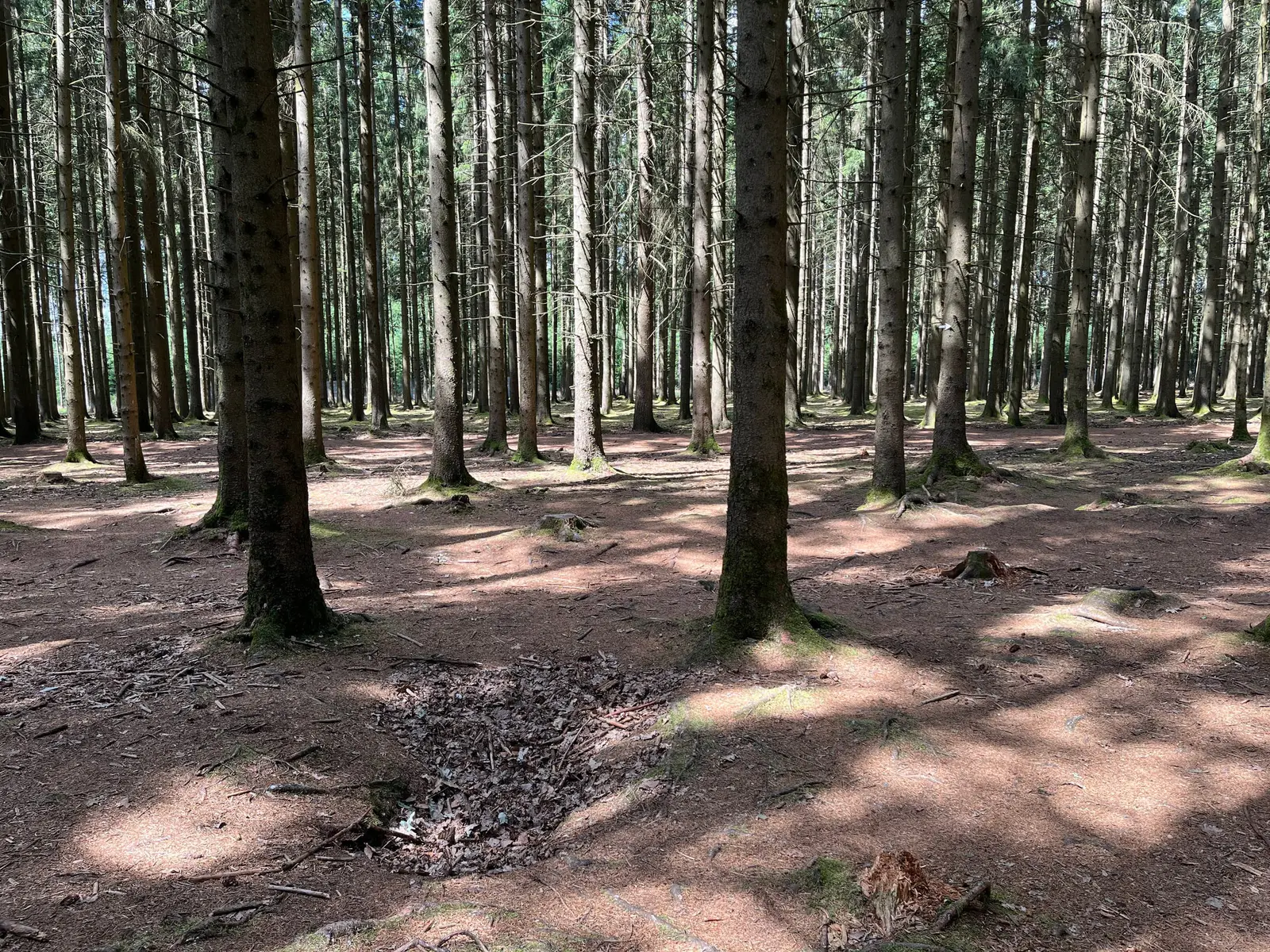
The foxholes are still there. Not markers, not reconstructions — actual depressions, shallow now after eighty winters of leaf litter, but unmistakably dug, unmistakably in pairs, unmistakably sited along the forward edge of the treeline where you would put them if you expected something to come out of the fields below. Some still have the spoil piled on the enemy side.
Easy Company came into this wood on 19 December 1944 and stayed in it, in the open, for the best part of a month, in temperatures down to around minus twenty, with snow two feet deep, rations cut and artillery ammunition rationed to a handful of rounds per gun per day. Trench foot took men out of the line as reliably as shellfire.
Follow the treeline north-west a few hundred metres and it opens onto a clearing looking downhill to a village of maybe two hundred houses. That is Foy, attacked on 13 January 1945 across open snow with no cover — the attack everyone remembers from the series, with Dike freezing in the middle of the field and Speirs sent forward to take over.
Everyone who has been says the same thing: the distance is much shorter than you expect, and that makes it worse rather than better.
Photographs · 5
Photographed on an earlier tour of this route, July 2023 — not on the September 2026 trip.
Place McAuliffe, Bastogne
A Sherman on display in the town square. It was knocked out south-west of here in December 1944 and has stood in the square since 1948.
Bois Jacques, Foy
The Bois Jacques, where Easy Company dug in to hold the line. In December 1944 the branches were the problem — shells burst in the canopy and came down as splinters.
Bois Jacques, Foy
Foxholes still visible where Easy Company held the line through the winter of 1944–45. “We demand your honourable surrender.” — “NUTS!”
Edge of the Bois Jacques, above Foy
The clearing at the edge of the wood, looking down onto Foy. Easy Company attacked across this ground on 13 January 1945 — open, snow-covered, no cover at all.
Bastogne
A cat at the hotel in Bastogne, photographed on the earlier tour. Nine days of cemeteries and casemates; you take the small things where you find them.
Where this was
This map repeats information already available as text. Every stop is listed in order on the timeline and in the journal index.
- Place McAuliffe, Bastogne
- Patton Monument, Bastogne
- Foxholes of Bois Jacques
- Foy