Day 5Monday, September 14, 2026Bastogne to Hamm, Luxembourg
Bastogne and the Luxembourg American Cemetery
1944
The Mardasson Memorial honours 76,890 American casualties of the Ardennes. Fifty miles south at Hamm, 5,073 Americans are buried, most of them killed in the same campaign — with Patton at the head of them.
2026
A full day on the Bulge: the Mardasson star, the vehicle halls and command cellar at Bastogne Barracks, two museums, and then south into Luxembourg to Patton’s grave.
The one day that stays put long enough to do the Bulge properly, and then drives fifty miles south to finish it.
Mardasson
On a hill east of town, an enormous five-pointed star in pale stone, dedicated in 1950, honouring the 76,890 American casualties of the Ardennes campaign. The names of every US state are carved around the top and the story of the battle is set out in Latin around the colonnade. The Bastogne War Museum sits beside it.
Bastogne Barracks
Not a museum in the ordinary sense — a Belgian Army site that includes the cellar McAuliffe used as a command post during the siege, and a working vehicle restoration centre.
The cellar, the Nuts Cave, is a low white-painted room with a few maps and field telephones, and by all accounts the hard thing is squaring its size with the size of the decision made in it.
The halls are the other draw: a Stuart, Shermans, a Panzer IV, a Jagdpanther, an 88 on its cruciform mount, restored to a standard you do not often see. Whether any particular vehicle is present on the day is a lottery — they go out for restoration and events — which is part of the appeal.
The 101st Airborne Museum in town, in a former officers’ mess used as a field hospital during the siege, rounds out the morning.
South to Hamm
Then across the border into Luxembourg, and up onto a wooded plateau east of the city.
Fifty acres, 5,073 graves. Most of the men buried here were killed in the Ardennes, a great many within a hundred kilometres of where they lie. Hamm is laid out differently from Colleville: where the Normandy cemetery is a grid on a bluff, this one follows the ground in nine plots on a broad curve, framed by beech and pine, so you never see all of it at once. Twenty-two sets of brothers. One woman — Elizabeth Richardson of the American Red Cross, killed in a plane crash in July 1945.
Patton
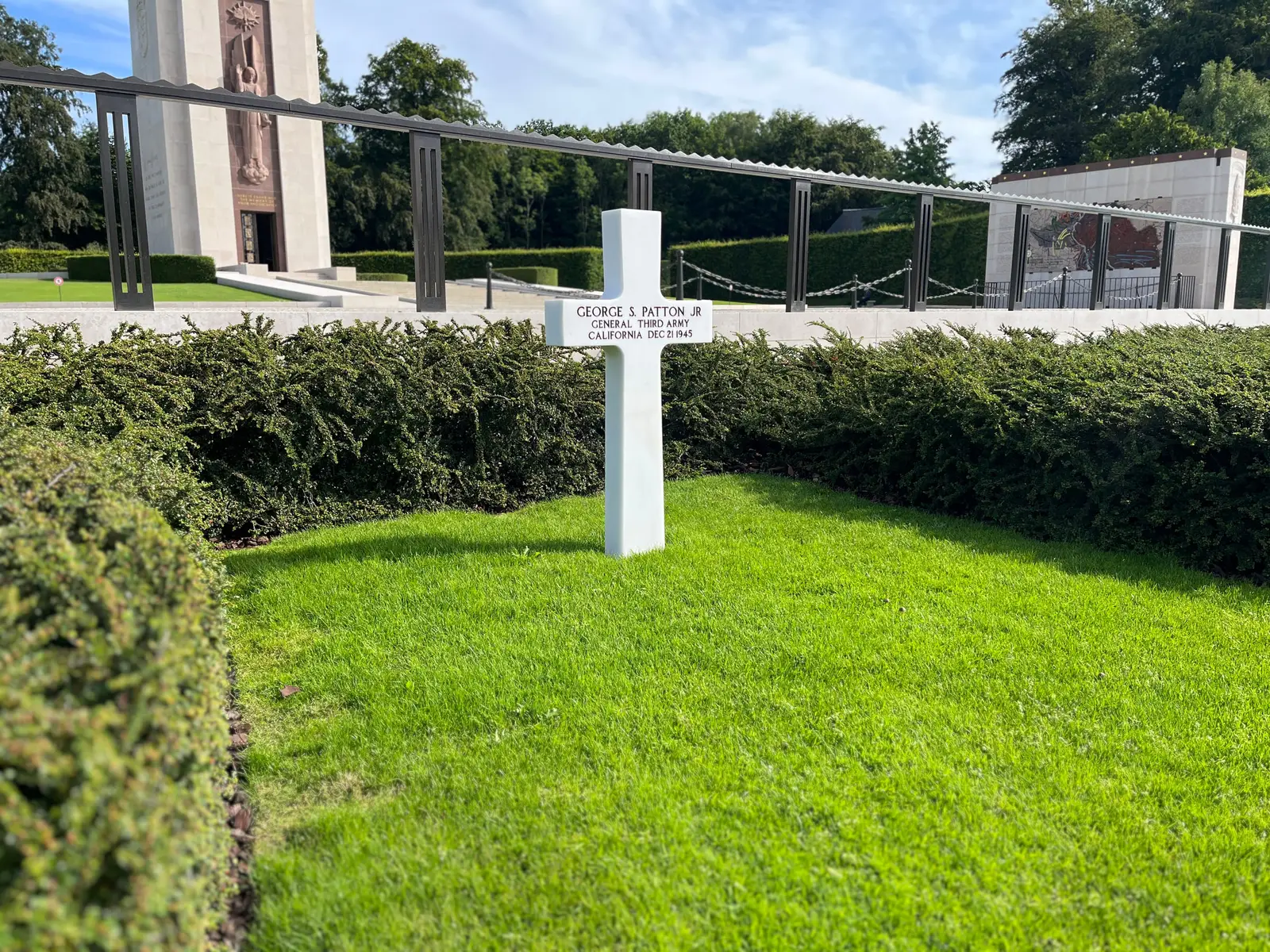
He is at the head of the plots, alone, under an identical white marble cross, facing the men.
He did not start there. He was buried on 24 December 1945 among the graves in the position the sequence gave him, and within a year so many people were coming to stand at it that the surrounding graves were being trampled and the grass would not grow. In 1947 he was moved to a spot where visitors could see him without walking over anyone.
The death is one of the war’s oddities. He had commanded Third Army through France, relieved Bastogne, and crossed the Rhine. On 9 December 1945, seven months after the German surrender, his staff car collided with a truck at low speed near Mannheim on the way to a pheasant shoot. Nobody else was badly hurt. He broke his neck and died in hospital twelve days later.
His wife declined repatriation. He had said more than once that a soldier should be buried where he falls, with his men, and she took him at his word.
The map by the entrance
There is a large engraved stone map of the campaign in Western Europe near the gate — arrows, dates, front lines from Normandy to the Elbe.
By this point in the tour it should be possible to put a finger on Utah, run it east along the coast, jump inland to Bastogne, come down to where you are standing, and keep going into Germany, which is where we go tomorrow.
Photographs · 9
Photographed on an earlier tour of this route, July 2023 — not on the September 2026 trip.
Mardasson Memorial, Bastogne
The Mardasson Memorial — a five-pointed star in pale stone, dedicated in 1950, with the names of every US state carved around the top. Renovation work was underway when this was taken.
Bastogne Barracks
An M5A1 Stuart in the vehicle hall. Bastogne Barracks is a working restoration centre for the Belgian Army, not just a display collection.
Bastogne Barracks
A restored Sherman. Vehicles here are maintained in running order by people who clearly enjoy their jobs a great deal.
Bastogne Barracks
A German Jagdpanther tank destroyer, restored down to the zimmerit finish.
Bastogne Barracks
A Panzer IV. By December 1944 this was an old design being asked to do a young tank’s job.
Bastogne Barracks
The dreaded 88. Designed for anti-aircraft work and then pointed at everything else.
Luxembourg American Cemetery, Hamm
The graves at Hamm are laid out in nine plots in a sweeping curve, following the contour of the ground rather than a grid.
Luxembourg American Cemetery, Hamm
Patton’s grave. He was buried among his men, but so many people came to see him that the grass was being worn away — so in 1947 he was moved to the head of the plots, facing them.
Luxembourg American Cemetery, Hamm
The operations map near the entrance. Standing in front of it you can trace the whole route this tour takes in about four seconds.
Where this was
This map repeats information already available as text. Every stop is listed in order on the timeline and in the journal index.
- Mardasson Memorial
- Bastogne War Museum
- Bastogne Barracks
- 101st Airborne Museum
- Luxembourg American Cemetery, Hamm