Day 7Wednesday, September 16, 2026Dachau & Munich, Bavaria, Germany
Dachau, and Munich Afterwards
1944
Opened 22 March 1933, seven weeks after Hitler became Chancellor. The first Nazi concentration camp, the model for all the others, and the training ground for the men who ran them. Liberated by American troops on 29 April 1945.
2026
The hardest day on the itinerary, and the reason the tour is worth taking. The memorial site in the morning; Marienplatz and the Hofbräuhaus in the afternoon, which is a strange sequence and probably the honest one.
Dachau opened on 22 March 1933. Hitler had been Chancellor for seven weeks.
That date is the thing to hold on to. This was not something the regime arrived at late, under the pressure of a war it was losing, in occupied territory far from home. It was one of the first things it did — twelve miles from the centre of Munich, announced in the newspapers, on the site of a disused munitions factory, for political prisoners: communists, social democrats, trade unionists, anyone the new government found inconvenient.
Everything that came afterwards was built on the template worked out here. The organisational structure, the guard training, the routines. Commandants of other camps were trained at Dachau; Rudolf Höss, who went on to command Auschwitz, learned his trade here.
The site
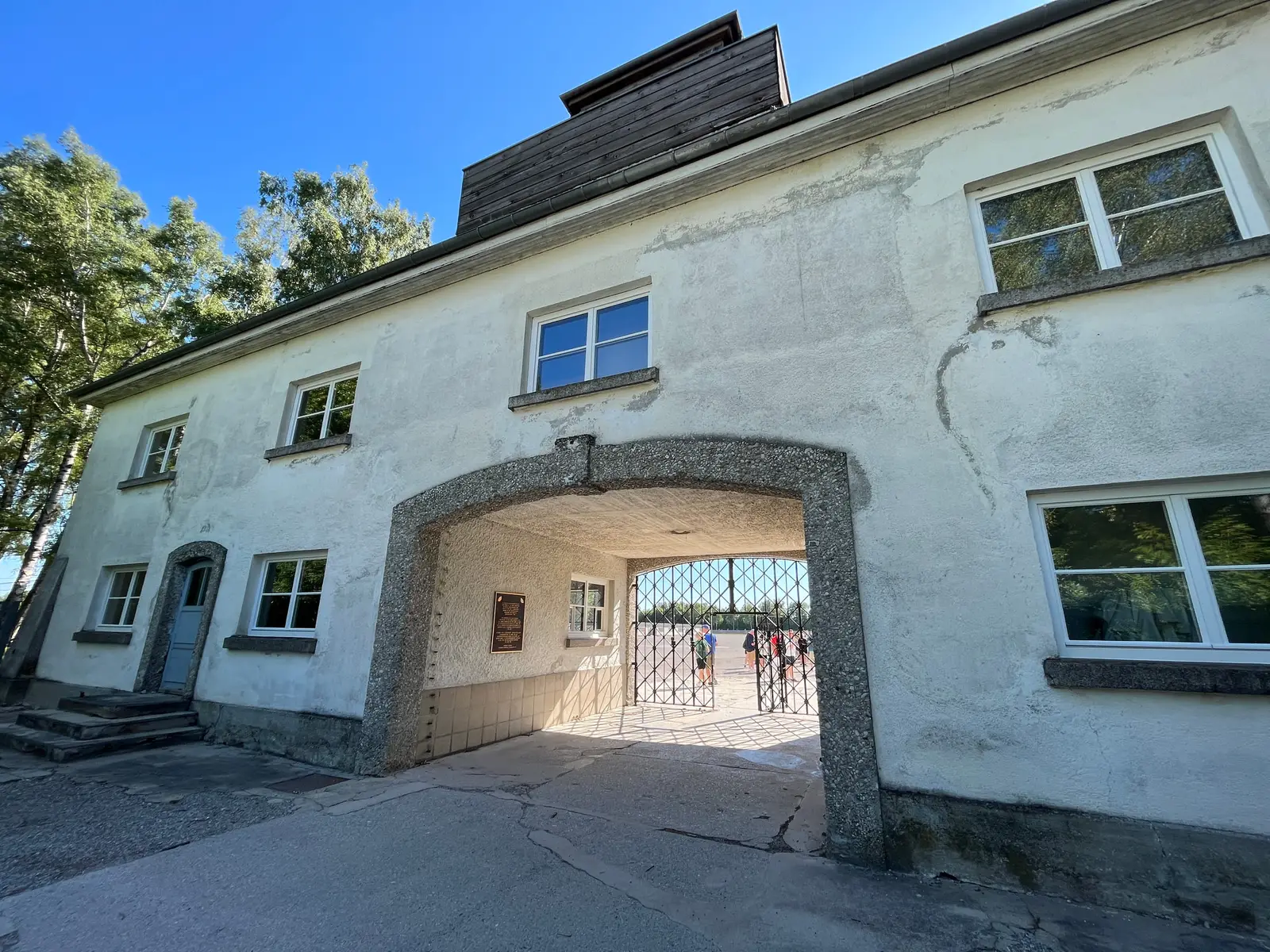
You go in through the Jourhaus, the gatehouse, because there was no other way in and there is no other way in now. The gate carries the words Arbeit macht frei.
The original was stolen in November 2014 and turned up in Norway two years later. It is now displayed inside, under cover, with a replica hanging in the gateway — a decision that reads oddly until you think about it and realise the alternative was leaving it exposed to whoever wanted it next.
Beyond the gate is the roll-call square, the size of several football pitches and completely empty. Prisoners stood on it to be counted, sometimes for hours, in any weather. On the far side, two reconstructed barracks and then the concrete outlines of the other thirty, running away in two rows with a line of poplars down the middle. At the far end, across a bridge, the crematorium.
Around 200,000 people were imprisoned here over twelve years and more than 41,500 are known to have died. The real figure is higher, because the record-keeping collapsed at the end along with everything else. Typhus was raging when the Americans arrived.
The liberation
Men of the US 42nd and 45th Infantry Divisions reached the camp on 29 April 1945, with no real briefing on what they were about to find. Outside it they came on a line of railway wagons holding around 2,000 bodies — prisoners evacuated from Buchenwald weeks earlier and left to die in transit.
Some of the guards who surrendered were shot. This is documented, there was an investigation, and no one was prosecuted. Historians have gone back and forth on the numbers ever since. I expect the guiding to raise it rather than skip it, because a sanitised version of this day would be worth nothing.
What I am not going to do
I am not going to photograph the interior of the camp, and when I write this day up properly, I am not going to describe it in detail either.
The memorial site is free, it is thirty minutes from central Munich on the S-Bahn, and it is documented in several languages by people who have thought much harder than I have about how to present it. If you want to know, go.
Munich afterwards
The itinerary puts Marienplatz and the Hofbräuhaus in the same afternoon, which looks tone-deaf written down and probably is not.
The Hofbräuhaus is a large, cheerful, extremely touristy beer hall that was also where the party held some of its earliest meetings — a fact the building handles by not mentioning it at all. Going from the camp to the beer hall in one afternoon puts the two things about four miles and eleven years apart, which is roughly the distance the city itself has to live with.
I imagine most of the group will not do very much that evening.
Photographs · 2
Photographed on an earlier tour of this route, July 2023 — not on the September 2026 trip.
KZ-Gedenkstätte Dachau
The entrance to the camp. The building is the original Jourhaus — the only way in, and the only way out.
KZ-Gedenkstätte Dachau
“Arbeit macht frei” — work sets you free. The original gate was stolen in 2014 and recovered in Norway two years later; it is now displayed under cover, with a replica in the gateway.
Where this was
This map repeats information already available as text. Every stop is listed in order on the timeline and in the journal index.
- KZ-Gedenkstätte Dachau
- Marienplatz, Munich
- Hofbräuhaus, Munich